
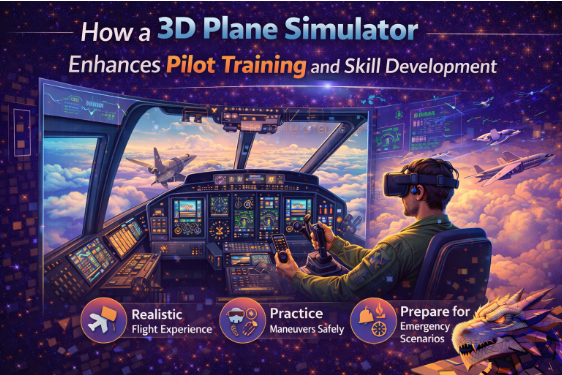
Pilot training has undergone considerable changes over the years. Where real aircraft training is no longer sufficient by itself to keep up with the demands of modern aviation, simulation-based training has become a core part in the development of pilots due to safety requirements, increased operational costs, and the complexity of modern aircraft systems. Central to this change is the 3D plane simulator, which turns upside down how pilots learn, practice, and fine-tune their flying abilities.
Simulation technology integrates realism, repetition, and risk-free learning, hence playing a critical role in shaping confident and competent pilots.
Emulation of Flight Scenarios
One of the most valuable features of a 3D flight simulator is that it can realistically simulate flying conditions. Modern simulators copy the cockpit layout, aircraft behavior, terrain, weather patterns, and air traffic scenarios in three dimensions.
Pilots might experience the following:
- The accurate Cockpit instrumentation
- Realistic physics of aircraft, realistic controls
- Visual depth and spatial awareness
- Dynamic weather and time-of-day lighting
This realism fills the gap between theoretical and practical knowledge of flying the aircraft to let pilots familiarize themselves with it before boarding a real one.
Safe Training for High-Risk Scenarios
Certain situations during flight are either too risky or so time-consuming that it would be impossible to practice them repeatedly on actual aircraft. Some emergencies, like engine failures, severe turbulence, or failure of a system, do require perfect decision-making, which cannot be emulated in the air itself.
A 3-D plane simulator allows pilots to train for these scenarios without risk. It can train pilots by:
- Emergency landings
- Instrumentation failures
- Adverse weather responses
- Complex approach and departure procedures
The controlled conditions also help prepare pilots psychologically for situations that are rare but critical, thus enhancing safety and building confidence.
Acceleration of Skills Through Repetition
Mastery of aviation skills is hugely dependent on repetition. However, to repeat the same maneuver in an actual aircraft can be very expensive and time-consuming.
Simulation negates these constraints. Pilots can practice takeoffs, landings, navigation, and instrument procedures repeatedly without fuel costs or airspace limitations. This repetition strengthens muscle memory, improves reaction time, and reinforces correct procedures.
Errors turn into learning opportunities, not expensive setbacks.
Support Structured and Progressive Training
The training for flying follows a logical progression, from basic maneuvers to more advanced operations. Three-dimensional simulators can support that by allowing the instructor to control training complexity.
This can be done by trainees starting with:
- Basic flight controls and orientation
- Simple exercises in navigation
And gradually progress to:
- Instrument flight rules (IFR)
- Multi-system aircraft management
- Advanced flight planning and execution
With a smooth learning curve, the abilities are built gradually and systematically, minimizing overwhelming and maximizing retention.
Improving Situational Awareness and Decision Making
One of the most important skills a pilot can possess is situational awareness. It requires great cognitive processing to understand aircraft position, airspace, weather, and traffic all at once.
3D simulation enhances this ability by presenting realistic and immersive scenarios that demand continuous awareness and judgment. Pilots learn to process information faster, prioritize tasks, and make decisions under pressure.
These decision-making skills are transferred directly to the real world of flight operations.
Enhancing Instructor-Led Training and Feedback
Simulators are also powerful instructor tools: the training can be paused, replayed, and even modified in real time to point out particular sequences.
Instructors can:
- Review pilot actions step by step
- Analyze mistakes without time pressure
- Provide specific feedback
This rigorous review process enhances learning outcomes and helps pilots understand not just what went wrong but why.
Reducing Training Costs Without Compromising Quality
Flight training is expensive. Aircraft maintenance, fuel, insurance, and airport fees add up quickly. Simulation greatly reduces these costs without sacrificing high training standards.
By incorporating simulators into their training programs, flight schools and aviation organizations can:
- Reduce operational costs
- Increase training frequency
- Improve accessibility to the trainees
High-quality simulation environments often leverage advanced 3D modeling services, which guarantee authentic aircraft behavior along with visuals in exacting detail at much less cost than physical training assets.
Training Pilots for Advanced Aircraft Systems
Modern aircraft are designed to rely heavily on digital avionics and automated systems. Complex interfaces and workflows must be understood by the pilot before operating them in real flight.
3D simulators mimic these systems correctly, enabling pilots to:
- Learn Cockpit workflows
- Practice system monitoring
- Respond to automation failures
Such familiarity reduces the transition time when pilots move to real aircraft and enhances general operability.
Supporting Ongoing Skill Maintenance
Pilot training doesn’t stop after certification. Skills must be maintained and updated throughout a pilot’s career.
Simulation enables experienced pilots to:
- Refresh processes
- Train on new aircraft types
- Stay on top of all regulatory requirements
This is continuous learning that ensures long-term competence and safety.
Conclusion
Modern aviation requires a great deal of precision, preparedness, and confidence, and such qualities are acquired through efficient training. The 3D plane simulator enhances training by offering a realistic, safe, and repeatable environment for pilots to develop their skills without any risk.
From emergency response and decision-making to system familiarity and cost-efficient repetition, simulation plays a significant role in shaping capable pilots. Supported by advanced 3D modeling services, these simulators provide the realism and accuracy required to train pilots in the intricacies of actual flying.
In today’s aviation environment, simulation is no longer a supplement, but rather one of the cornerstones for pilots’ skill development and flight safety.